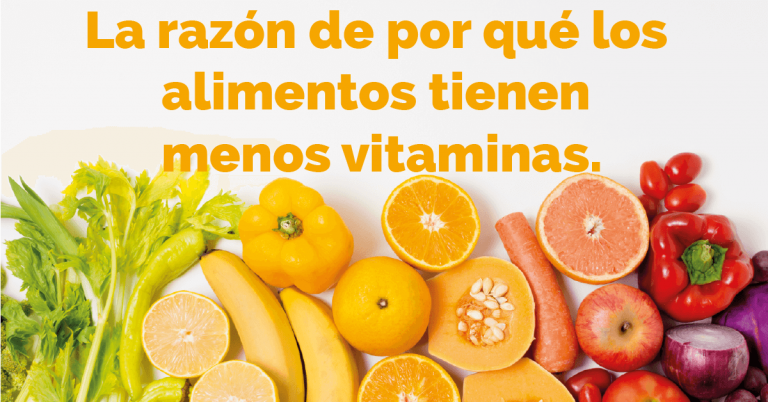
Foods: increasingly with fewer vitamins
Foods have fewer and fewer vitamins and that's why we get sick more and more often and we can't lose weight...
But years ago we were already warned that spinach would have less vitamin C, that broccoli has almost no calcium or that other vegetables contain 80% less nutrients than in previous years. Even a study carried out by the University of Tokyo states that because of CO2 the rice we will eat in the future will be less nutritious makes us question what is happening with the nutrients in the food we put on our table. * ##Who is to blame? Experts point to four factors as responsible for the loss of nutritional density of our food. The first of those reasons is that we failed at the base, in this case, because of our agricultural soils. The earth, as we have treated it, is exhausted. Farmers know this and that is why they provide chemical fertilizers, nitrogen, phosphorus, potassium… All the necessary elements for the plants to grow, but something is not working as it should because something else needs to be added. Just as we need a varied bacterial flora to be healthy, the soil in which everything we eat is grown also requires its own legion of microorganisms. “It is as if we put a cocktail of minerals at the disposal of the plant but it cannot absorb them. On many occasions they come to our laboratory to analyze soils in which ‘manifestation of chlorosis’ is indicated. Chlorosis means that a lack of iron has occurred in the leaves of the plant despite growing in soil in which there is plenty of iron. *
Variety: more production, less vitamins
There are also other factors of the “flight” of vitamins such as microscopic bugs aside, in addition to “genetic improvements.” The objective for decades has been to obtain many kilos per hectare, and let’s not fool ourselves, that has allowed the population to grow and not starve. The problem is that we focus on producing more, but with less quality. But these new varieties with accelerated maturation and XXL sizes do not allow the plant, from a biochemical point of view, to do its job well. Furthermore, the harvests are premature (up to 15 or 20 days earlier than they should) and the ripening occurs in a chamber, an environment in which a fruit or vegetable can vary its balance of acids and sugars. But it cannot synthesize a single vitamin because it is not absorbing any nutrients and, evidently, it has also stopped accumulating minerals. *
What can we do?
If this scenario continues over the next few decades, it is worth asking whether in a few years the motto of greater quantity and less quality will have to be changed. And while we decide if the solution is to eat more of what we already eat or take vitamin supplements of dubious effectiveness.
What is the solution?
Cambridge is a formulated food (or meal replacement) that gives your body all the nutrients it needs. In other words, when you eat a Cambridge product, it is as if you were eating a balanced dish that gives your body the Minerals, Vitamins, Carbohydrates, Proteins and Fats it needs. At first, this formulated food was exclusive to astronauts who had a mission in space (that’s why it looks like a milkshake). But believe me, even though it looks like a milkshake, it will strengthen your immune system and you will be in less danger of getting sick. Plus, it will fill you up until your next meal, meaning you won’t suffer from hunger or cravings. Now anyone can eat it because it has permission from world organizations like COFEPRIS. This means that it will not cause any harm to your body, on the contrary, it will make it healthier and in the end you will look and feel spectacular. If you want more information on nutrition and health topics, or need advice to find the healthiest eating plan to help you lose weight, click here *